I hope you enjoy this video about finding deeper meaning (i.e., making inferences) by using text clues. Happy Reading!
Saturday, October 26, 2019
Reading Video - Making Meaning with Text Clues
I hope you enjoy this video about finding deeper meaning (i.e., making inferences) by using text clues. Happy Reading!

Thursday, October 24, 2019
The Outsiders (Chapter 7-12)
---------------------------------------------------------------------------------------
Note: There will be no "spoiler button" on this post, since it is impossible to discuss the second half of The Outsiders without delving into the major plot points. If you haven't read the novel in its entirety, I implore you to close your device, read the book, and take some time to reflect. Trust me, it's worth it!
With that said, spoilers below:
---------------------------------------------------------------------------------------

"Stay gold, Ponyboy. Stay gold."
-Johnny Cade, Chapter 9
There are few last words as memorable in young adult literature as those spoken by Johnny as he lay dying from wounds sustained in the church fire only a day prior. Ponyboy and the other greasers had just beaten the Socs in the rumble, but the celebration was cut short when Johnny's condition took a turn for the worse.
After his loss, the greasers exemplified different stages of grief. Most of them vacillated between depression and acceptance, but Dally was swept up by anger at Johnny's death. He robbed a grocery store and committed suicide by police, threatening the officers with an unloaded gun to force them to shoot him.
While Ponyboy reeled from the loss of both Johnny and Dally, his conflicts with Darry escalated while his grades slipped. Sodapop finally brought the brothers together when he broke down over constantly being in the middle of their fighting. Ponyboy's English teacher offered to pass him if he submitted a well written final theme. He realized that only he can tell the story of Johnny, Dally, and all the other greasers. His theme began with the opening words of the novel: "When I stepped out into the bright sunlight from the darkness of the movie house, I had only two things on my mind: Paul Newman and a ride home."
Elements of Fiction - Main Conflict, Climax, Resolution
Initially, the story builds toward the big rumble between the greasers and Socs as being the climax. However, the fight itself is anti-climatic when the greasers easily win. One might argue that Johnny's death is the true climax, but I believe it occurs much later when Ponyboy discovers the letter from Johnny. This illustrates that the main conflict was not just the battle between the two groups, but rather Ponyboy's internal struggle to grow up amidst so much tragedy and violence. The resolution is his acceptance of Johnny's death and writing his theme about his life as a greaser.
To help students unravel these important elements, I would have them diagram the plot points, especially focusing on the conflict, climax, and resolution. I would have students explain why they chose specific parts for those elements. It is important to understand how those elements work together, rather than just picking the most exciting part of the story as the climax.
Film Version
Another activity that could help students understand the major themes in The Outsiders would be to watch the film version. Students can increase their understanding of the novel by comparing the two versions to find similarities and differences. Depending on my students, I might wait to watch the film until we have read the whole novel in order to experience each as an independent work. Or, we might watch segments of the film after we've read that part in the novel in order to help students who struggle with reading comprehension access the important parts of the story. It would depend on the level of my students.
While I generally reside in the "The Book Was Better" camp, I think the film adaptation is very well done and would not hesitate to use it as part of my instruction. Both the film and the book draw the viewer/reader into Ponyboy's world and demonstrate his struggle to find his place.

Source
Hinton, S. E. (1967). The outsiders. New York, NY: Penguin Books.
Wednesday, October 16, 2019
The Outsiders (Chapters 1-6)
"It seemed funny to me that the sunset she saw from her patio and the one I saw from the back steps was the same one. Maybe the two different worlds we lived in weren't so different. We saw the same sunset."
- Chapter 3
In The Outsiders, S.E. Hinton draws the reader into the life of 14-year-old Ponyboy Curtis - a member of a lower-class gang known as the greasers. He and his fellow East side friends are constantly at odds with the Socials (or Socs) from the West side. Ponyboy lives with his older brothers, Sodapop and Darry, since his parents died in a car crash. Other greasers include Dally (a toughened criminal), Steve (Sodapop’s best friend), Two-Bit (the jokester), and Johnny (Ponyboy's close friend who is still scarred from being jumped by the Socs).
When Ponyboy and Johnny get attacked by a group of Socs for spending time with the "wrong" girls, Johnny kills a Soc in self-defense. The two boys hide out in an abandoned church in a nearby town until Dally comes to retrieve them. They learn that the violence between the greasers and Socs has escalated and that one of the girls, Cherry, is acting as a spy for the greasers.
On their way home, they see that the church has become engulfed in flames. While helping save a group of schoolchildren from the burning building, Johnny is struck by a piece of timber. Ponyboy has a sense of calm as they head home, though the reader is left feeling dread for the upcoming battle.
A Different Time
Since this book was published over 50 years ago, students may have trouble understanding the setting and cultural references. I would use a variety of music, videos, and photographs to illuminate the references to Paul Newman, the Beatles, Elvis Presley, corvettes, mustangs, and the different clothing styles of 1960's teens.
Character Analysis
The variety of characters presents another challenge in reading this novel. To help students keep track of the main characters, they can create a character guide for reference. As they learn new details about key characters, they can add them to their guide. This might be done as a jigsaw activity in which groups of students analyze different characters and create a poster to show their character's name, nicknames, physical characteristics, personality traits, relationship to other characters, and any other relevant information.
 |
| A sample character poster from a 7th grade language arts class. |
Still Relevant
It's incredible that the themes throughout this story are still relevant for teens today. Almost everyone goes through a struggle to find their place, throughout which they are shaped by the people around them. Hinton was only 15 when she began writing the novel, which is evident through how she conveys the teenage experience. The greasers and Socs are trapped in a cycle of violence that, unfortunately, continues to be prevalent in many communities. Furthermore, Ponyboy explicitly states that this violence is born from the differences in their social classes.I look forward to reading the end of the novel to find out what happens to this ragtag family!
Sources
Croy, S. (2018, May 17). The outsiders character autopsy project! [Twitter post]. Retrieved October 16, 2019, from https://twitter.com/mrs_croy/status/997114841335820288.
Eby, M. (2017, April 26). Why 'the outsiders' still matters 50 years later. Retrieved October 16, 2019, from https://www.rollingstone.com/culture/culture-news/why-the-outsiders-still-matters-50-years-later-194014/.
Hinton, S. E. (1967). The outsiders. New York, NY: Penguin Books.
Thursday, October 10, 2019
Hatchet (Chapters 11-19 & Epilogue)

Come on, he thought, baring his teeth in the darkness—come on. Is that the best you can do—is that all you can hit me with—a moose and a tornado?
- Chapter 16
After failing to be rescued by a passing airplane, Brian plunges into depression and even tries to end his own life. He comes to accept that he is no longer the same person who crashed so many weeks ago. Rather, he is stronger and more resilient. He even refers to his actions as things that "new Brian" does and things that "old Brian" would have done. "New Brian" is able to survive a moose attack and a tornado - talk about a bad day!
Click below for many, many spoilers.
Difficult Themes
Brian's suicide attempt is a tricky part of the story, when it comes to discussing this book with students. I don't think that the topic of suicide should automatically mean the book can't be read by middle schoolers. However, I do think it should be handled delicately. Even though Brian comes to believe in his ability to survive without being rescued, he still struggles with loneliness and having to overcome many failures. It can be dangerous to convey the idea that one can simply "toughen up" and get over depression because that's just not the nature of the beast. It's more beneficial to focus on the theme of learning from failure, rather than just on the power of positive thinking.I would consider using this as a read aloud depending on the age and maturity level of my students. Even if I didn't read it aloud or assign it as independent reading, I would definitely have it in my library and recommend it to students who enjoy stories about survival.
STEM Connections
Brian's struggle to survive in the wild lends itself perfectly to challenge-based learning. The students can use math, science, and engineering to devise their own plan for surviving. You could even look at different areas that Brian may have been stranded to see if your survival plans change based on the location.Sources
Paulsen, G. (1987) Hatchet. New York, NY: Bradbury Press.New York Public Library (Producer). (2016, August 31). Live chat with author Gary Paulsen (K. Ralston, interviewer). [Live IM chat transcript]. Retrieved from http://www.npr.org/2011/04/22/135634400/science-diction-the-origin-of-the-word-robot
Thursday, October 3, 2019
Hatchet (Chapters 1-10)
"He did not know how long it took, but later he looked back on this time of crying in the corner of the dark cave and thought of it as when he learned the most important rule of survival, which was that feeling sorry for yourself didn't work. It wasn't just that it was wrong to do, or that it was considered incorrect. It was more than that—it didn't work."
- Chapter 8
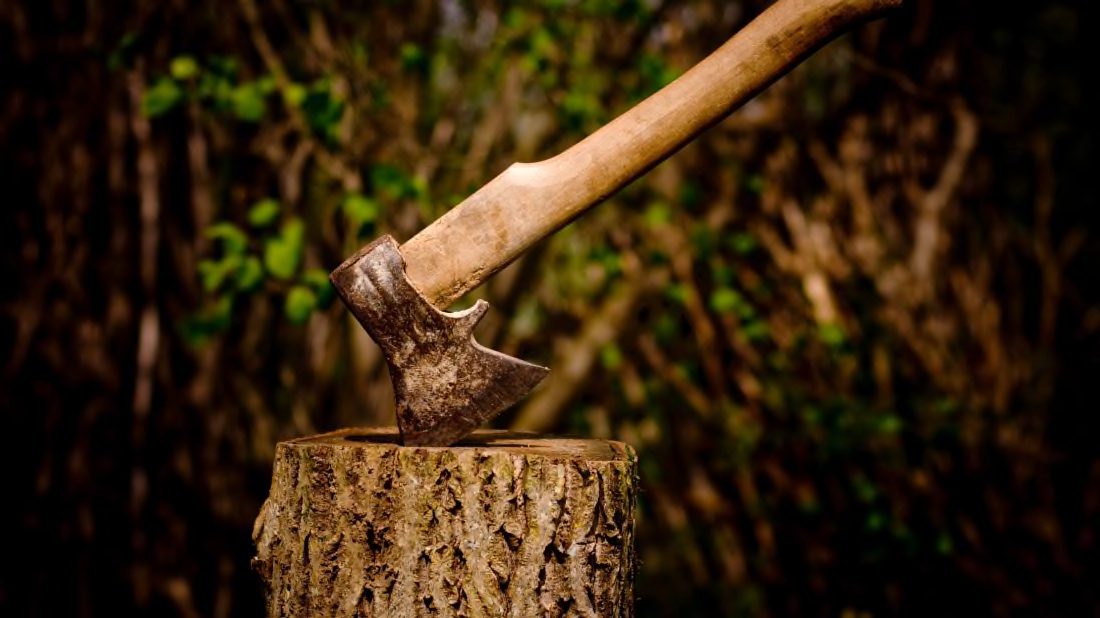
What would you do if you were 13-years-old, clutching the wheel of a small, twin-engine Cessna with a dead pilot in the seat beside you? This is where Brian Robeson finds himself in the beginning of Hatchet by Gary Paulsen. He manages to crash-land in a lake, but his relief at surviving the crash is cut short by the realization that he is now lost and alone in the middle of the Canadian wilderness. The only tool he has is the titular hatchet. In the first 10 chapters, he faces swarming mosquitoes, a brief bear encounter, and a defensive porcupine - all while trying to figure out how to find food, shelter, and warmth.While the main plot unfolds, Brian also flashes back to the events which led to him being in the airplane in the first place. The reader learns about his parents' divorce and "The Secret" about his mother that he wasn't supposed to know. His mother had gifted Brian the hatchet before he left to visit his father, who works in the oil fields in Northern Canada.
I haven't decided yet whether I would want to use this book as a read-aloud or assigned reading in my classroom. If I were to use it, the following are some activities/elements of fiction that would align with the reading:
Journal Activities
As students read/listen to this book, one activity that would support their comprehension is to keep a reading journal. As Brian tries to survive in the wilderness, he has many success and failures. Students may not be able to relate to his exact situation, but learning from our failure is an important lesson. At the end of each chapter, I would have students write about any successes/failures that Brian had and what he learned from each. This would lead to a class discussion about whether he learned more from his successes or his failures. How did he turn some of his failures into successes?Foreshadowing
Paulsen uses strong foreshadowing throughout this novel. He hints at the pilot's death with the arm/stomach pain, and even foreshadows Brian having to land the plane himself when he briefly takes the wheel in the beginning. Finding examples of foreshadowing is like finding Easter eggs in a TV show, movie, or video game. It requires close reading and processing how the story unfolds. Some students will enjoy the task more than others, but this book is a great model for this element of fiction.
Source
Paulsen, G. (1987) Hatchet. New York, NY: Bradbury Press.
Grammar Video - Comma Splice
This video ended up a bit longer than I expected. I tried to tackle a pretty big topic!
Thursday, September 26, 2019
The BFG (Chapters 13-24)

"That's why they always put two blank pages at the back of the atlas. They're for new countries. You're meant to fill them in yourself."
-Young Pilot, Chapter 22, Capture!

I can't deny that the beginning half of The BFG moves at a rather slow pace. I tend to enjoy descriptions of characters and setting more than exciting plot, so I hadn't noticed until reading my group-mates reactions to the first 12 chapters of the story. However, the 2nd half picks up speed as Sophie and the BFG endeavor to stop the other giants from guzzling humans.
After learning that the giants are going to England (Sophie's home country) to eat schoolchildren, she convinces the BFG to help her. The BFG mixes a special dream to convince the Queen that the giants are (a) real and (b) a serious problem. In the dream, he tells the Queen that he and Sophie want to stop them. He even shows a little girl sitting on the Queen's bedroom windowsill. According to their plan, when the Queen wakes up, she'll find Sophie in her bedroom, and she'll have to believe that the whole dream was real!
As crazy as this plan is, it actually works. The Queen's maid, Mary, finds Sophie on the windowsill. Not only that, the dream matches with the events of the previous night as the giants snatched children from boarding schools around London. Sophie introduces the BFG to the Queen, who takes the whole situation remarkably well, considering she is meeting a 24-foot-tall giant.
The Queen has her butler, Mr. Tibbs, prepare a special breakfast for her guests. As you can imagine, incredible accommodations must be made to provide seating, utensils, and enough food for the BFG. After the BFG eats the entire contents of the royal kitchen, the Queen calls leaders from various countries to learn that similar events are happening all over the world. She decides that her entire Army and Air Force must be deployed to capture the giants.
Sophie, the BFG, the Head of the Army, and the Head of the Air Force take off for Giant Country with a fleet of "bellypoppers" (helicopters) to catch the giants!
Pacing
The pacing in the second half is a little quicker than the first half, especially while our heroes are trying to capture the giants. However, I would not use this book as a model text for good pacing. Roald Dahl slows down much of his story-telling to provide excessively in-depth descriptions. Some readers may find themselves bored by the many pages devoted to executing a royal breakfast or traveling to and from Giant Country.
Students may need assistance to pick out the important plot points in the story. You could have students use StoryboardThat to make a visual representation of how the events unfolded. They would also have to use the descriptive language to find details to include in their pictures.

 |
These are some sample storyboard squares
for the beginning of The BFG.
To see the entire storyboard, click here.(Spoiler warning!) |
Themes
There are many themes in this story about friendship, not judging people by their appearance, believing in yourself, and making morally right choices. I especially loved the part where the BFG is leading the helicopters to Giant Country. The military men are afraid of this unknown land that they can't find in their atlases. Yet, the young, adventurous pilot assures them that discovering new places is the very purpose of those blank pages at the end of the book. I want my students to know that it's okay to go outside of their comfort zones. They never know what wondrous things are lurking at the edge of their imagination!

Sources
Dahl, R. & Blake, Q. (1982). The BFG. Harmondsworth, Middlesex, England: Viking Penguin.
Murphy, M. (2019, January 19). The BFG storyboard. Retrieved from https://www.storyboardthat.com/storyboards/morganmurphy92431/the-bfg-storyboard.
Subscribe to:
Posts (Atom)